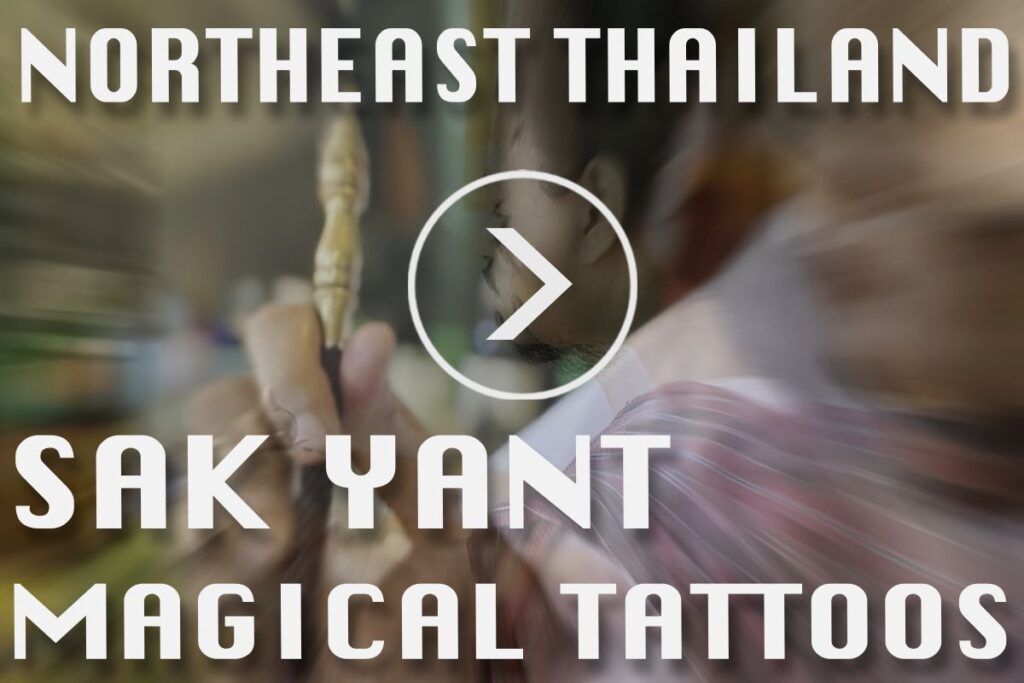
Sak Yant: Magical Tattoos and the Weight of Intention
Originating in the ancient Khmer Empire—now called Cambodia—Sak Yant is a spiritual practice of tattooing that dates back well over a thousand years. Ninth century. Before borders. Before they mattered.
Sak means to tap, or to inscribe.
Yant comes from the Sanskrit yantra—a sacred design, a mystical diagram, a language meant more for the unseen.
The literal translation: Magical Tattoos.
Sak Yant is performed today as it was then, using either a mai sak—a bamboo stick—or a khem sak—a metal rod. Both are ancient tools, differentiated not so much by lineage as by use.
Sak Yant is not done in tattoo shops.
It can’t be bought.
It’s received.
The ceremony is facilitated by an Ajarn, a Sak Yant Master who dedicates their life to spiritual study—learning from elder masters, carrying lineages forward, and shouldering knowledge that isn’t written down anywhere.
About forty minutes outside our village lives a Phram named Nop, a highly respected Ajarn. Remote doesn’t cover the location. You drive until the road is no longer a road, and then you keep going—until you arrive at a place quiet enough to hear the breath of your own intention.
Nop isn’t a novelty. He’s the real thing. Walking with monks. Sitting in the mountains. Generational. Disciplined. Widely sought after.
He’s summoned to places like Hong Kong, Taiwan, and Malaysia to perform Sak Yant ceremonies. And sometimes—if you show up and the energy is wrong, if the intention is off, even by a whisper—the answer is a quiet no.
No theatrics.
No explanations.
Just… not now.
To receive Sak Yant from a master like Nop isn’t a transaction. It’s a moment of alignment. The power of the ceremony is transferred through guttural breath, mantra, and sacred lineage.
Once received, you’re said to be cleared of lingering misfortune. Protected from black magic. Shielded from intention meant to harm.
And energized—with clarity, momentum, and good fortune—for the path you’re already walking.
But only if you arrive honest.
Only if you arrive ready.
Because this ceremony isn’t about the tattoo.
It never was.
If you come looking for something specific, a tattoo shop might be a better choice.
This is about what you’re willing to carry—
and what you’re finally ready to let go of.
And in the end, it becomes a quiet test— of whether you’re willing to trust the Master with the message you’ll carry with you for the rest of your life.
There’s a moment in my book—Scene Nine—where a sacred tattoo ceremony is revealed. Like much of the story, it actually happened. Maybe not exactly as written. Maybe not in that order.
But it was always going to happen.
The writing just got there first.