Ban Kan Throm, Thailand
by William Snyder
Listening to the familiar sounds of daybreak over coffee, on the elevated covered porch of our stilted village home, I spotted her in the distance.
Even from that range I could see the small bag in her left hand as she moved from house to house, stopping briefly at each one, exchanging a few words, offering something, then continuing on. It was an unhurried rhythm. No urgency. Just an easy purpose carried from doorway to doorway.
Eventually she closed the distance and made her way to our home.
Moments before she arrived, my wife had already walked down the stairs and was waiting at the end of the driveway to greet her. They shared a brief conversation. The woman reached into her bag, pulled out two white candles, not the kind that go on a birthday cake, but not much bigger, and handed them to my wife.
They exchanged a traditional wai, palms pressed together followed by a subtle bow of the head. Then she turned and continued down the road toward the next house.
Candles clutched in hand, my wife ambled back up the stairs, pausing halfway to pinch off a few dying leaves from the plants hanging along the railing. She reached the top, set the candles on the table, and sat back down beside me as if nothing unusual had happened.
We sat quietly, listening to the chickens argue with the sunrise.
I didn’t inquire. She didn’t offer.
I had learned a long time ago not to ask too many questions. My wife never objected to them. Quite the opposite. She would happily follow me into deeper waters whenever I wandered there. It’s just that what often followed began as a mostly indistinguishable string of words that had a better than good chance of drifting slightly off course. Somewhere between my limited Thai and her limited English, meaning had a way of taking the scenic route. I’d learned that if I simply let things transpire, clarity usually arrived on its own, and often with more texture than any explanation could offer.
So I had settled into the more simplistic approach of letting things unfold as they will.
It was a rather blissful state, truth be told. I was in capable hands, and chances were good I would eventually find out what the candles were about anyway. Or at least where we might be going. Or who might be coming over. Chances were also good that whatever I discovered would be either interesting or fun.
Often both.
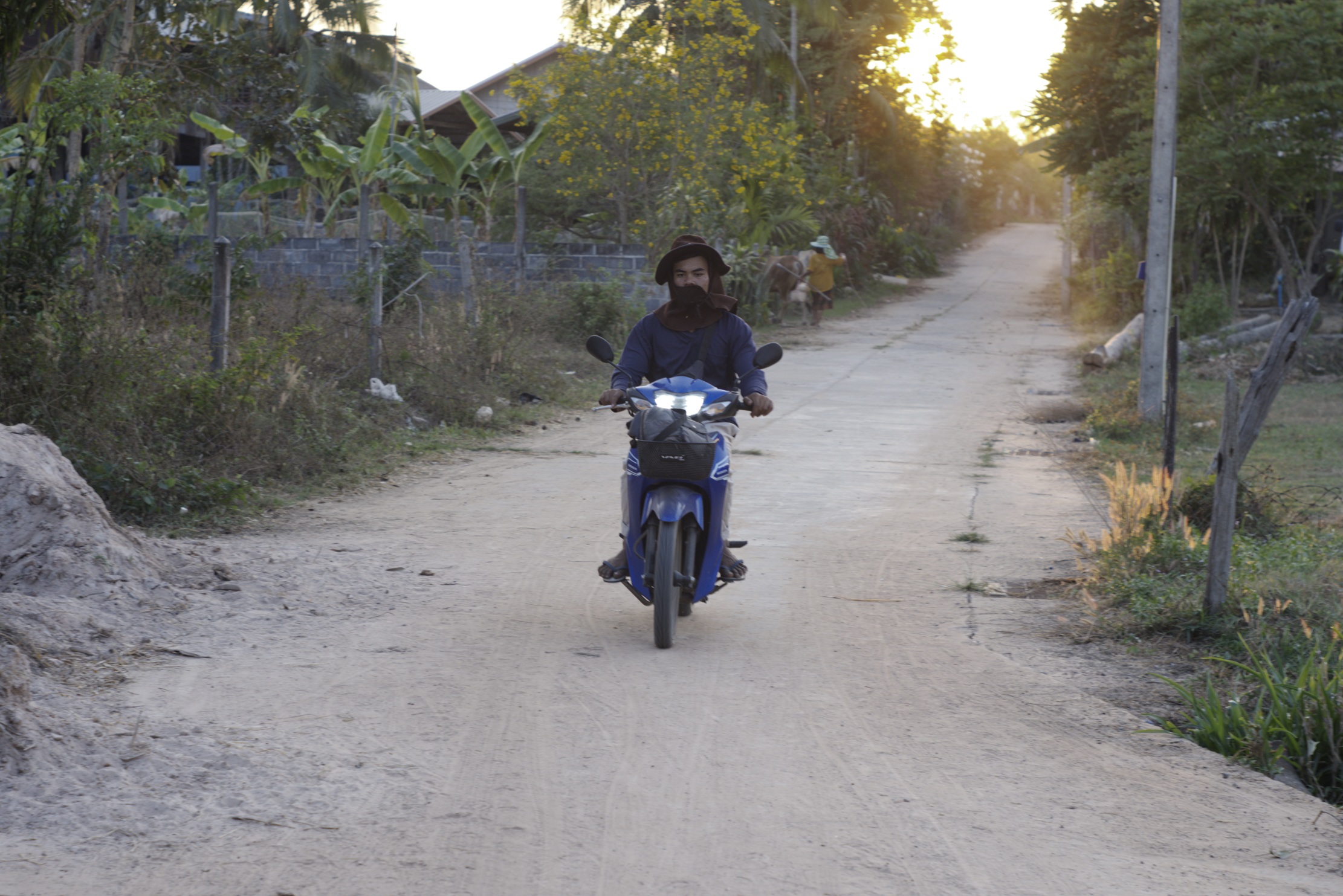
We finished our coffee slowly as the village gathered itself into the day. Engines coughed awake. A motorbike passed in a slow roll of dust. A radio somewhere down the road clicked on and filled the air with familiar morning chatter. A dog stretched itself awake beneath the house. A neighbor swept the dirt in front of their home, pushing yesterday into a small pile that would eventually disappear.
Nothing dramatic. Just the quiet accumulation of motion.
Eventually my wife wandered off to begin her day, and I walked back through the house and out the other side to a second elevated porch where I had set up my office and studio. It was more secluded there, shaded by an oversized overhang and a few trees, with a long view out over fields that shifted color depending on the season.
Throughout the day she would pop in from time to time, encouraging me to stand up and walk around. We shared lunch. The rhythm of the afternoon drifted along in the same unhurried way the morning had begun.
Around six o’clock she appeared again, this time leaning her head through the studio doorway.
“We go in one hour. Get ready.” she said.
Ready for what, I wasn’t entirely clear.
Honestly, it didn’t matter much.
After spending much of the day in a grudge match with the mostly blank page staring back at me, I was more than ready for whatever waited beyond the dirt road. The air had begun to soften as the sun eased toward the horizon, and the village had entered that gentle transition between day and night, when things begin to gather again, but in a different direction.
I closed the laptop, stood up, and stretched.
Whatever the candles had set in motion that morning, it seemed I was about to find out.
I had deduced earlier, through an overheard phone conversation, that we’d be going to Kantrom Noi, an adjoining village distinguished from ours only by a signpost I couldn’t read. With roughly just three hundred homes between the two villages combined, it was close enough to walk. Easily.
But we took the motorbike anyway.
Motorbikes are the primary mode of transportation throughout much of Asia. Here, they formed the pulse of daily movement, darting back and forth along dirt roads and narrow sois from sunrise until well after dark. They came in an interesting array of configurations. Some were fitted with sidecars that pulled double duty as people carriers and supply haulers. Others had small trailers in tow, stacked with freshly cut grasses for cows or heavy sacks of rice. Many, with neither sidecars nor trailers, carried entire families balanced along a single narrow seat.
You might expect the arrangement to be dad, child, child, mom. Or maybe mom, young child, older child. And sometimes it was.
But more often than not, you’d see the youngest on the back, clinging to whoever’s shirt in front of them, bouncing precariously yet somehow balanced on the tiniest remaining edge of the seat, their small legs flailing freely in the wind without a thought or care in the world.
Perfectly normal here.
Dogs joined the choreography too. It wasn’t uncommon to see two full-sized dogs standing confidently on a single seat behind their owner, riding along a bumpy road, not slowly either. Their ears pinned back, bodies swaying gently with each rut and rise, as if this, too, was just another Tuesday.
A few minutes past seven we pulled out of our driveway, turned right, and barely a minute later made the left turn onto the soi that cut through to Kantrom Noi. The sun had already slipped well below the horizon, leaving behind that dim light that lingers just before the full blackness of night settles in.
Even from a distance I could see a line of motorbikes ahead and a tall vertical strip of surprisingly bright fluorescent light illuminating them and the surrounding area. A faint haze hung in the air to the left, as if something was stirring the ground just enough to lift a thin cloud of dust.
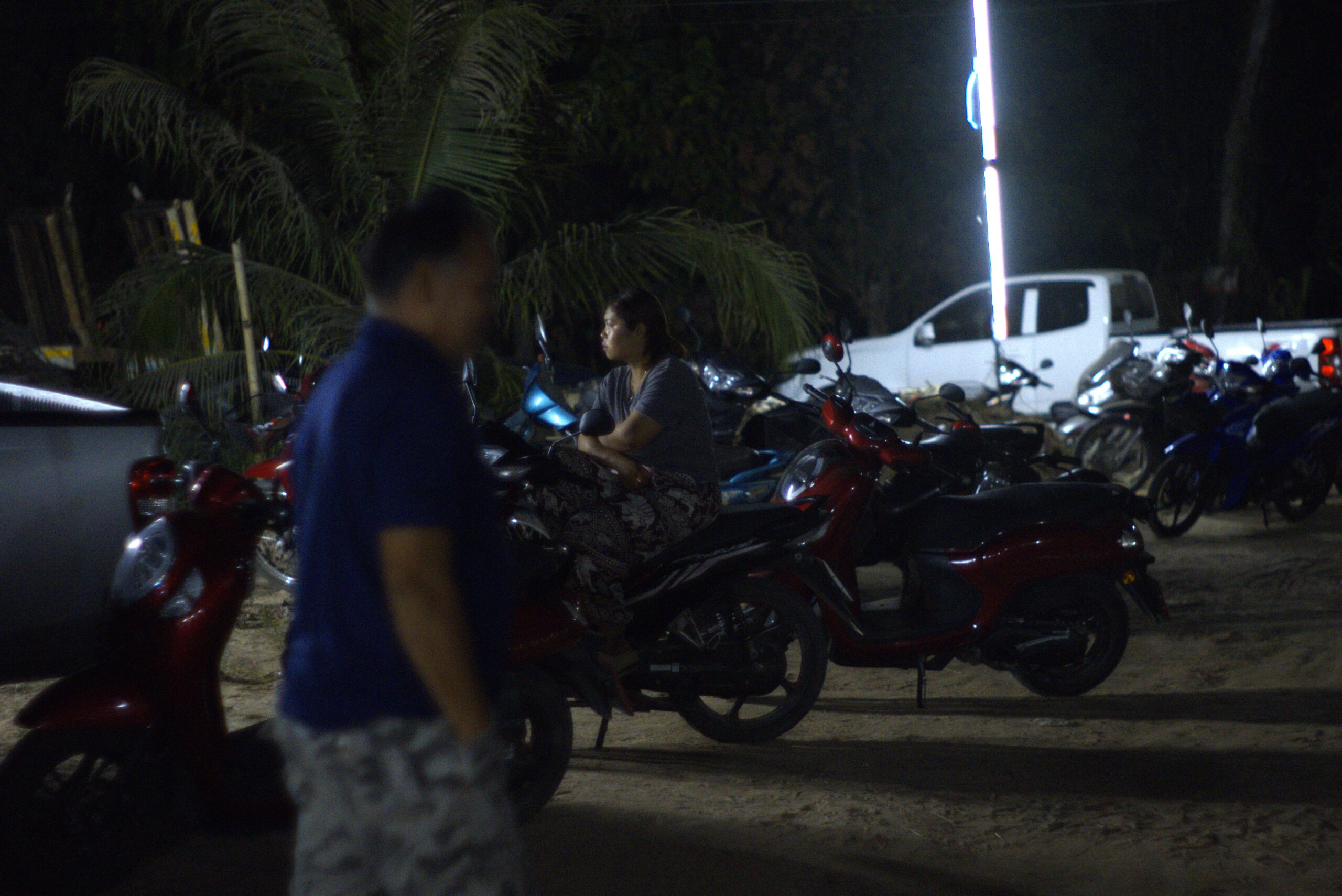
As we approached, my wife instructed me to continue past the other motorbikes and pull directly into the driveway of the home where the gathering was being held, claiming a prime position up front.
As was usually the case at family gatherings, which I had assumed this was – although I didn’t recognize the house – my wife slipped off the bike, tote full of various “visiting folks” essentials draped over her shoulder, and disappeared into the small crowd that had formed. She did this with the ease of someone stepping into a current that already knew her name well.
I was left to wander on my own for a while.
I didn’t mind. In fact, I appreciated the elbow room. It gave me time to orient myself at my own pace. I recognized a number of faces and exchanged as many smiles and “sawadi kraps” as I could – the standard Thai greeting that had long since become second nature. It didn’t take long to feel comfortable.
So I wandered.
The concentration of bodies gathered on the left looked dense and difficult to penetrate, so I skirted along the perimeter, drifting into an open corridor beneath an awning where a handful of tables and plastic chairs had been set up. I paused there, trying to determine my next wandering coordinates.
Lingering in this in-between space were a handful of people, including a young girl wearing fingerless gloves, a coat with the hood pulled up over a helmet, and a trucker hat bill protruding from beneath it all. She carried a slim wooden case, opened like a small traveling display, neatly arranged with lottery tickets.
Lottery ticket sellers materialized at nearly every gathering, big or small. A new patch of cement being poured. A funeral. A wedding. A birthday. A gathering of three people under a tree. Wherever people assembled, the possibility of luck followed.
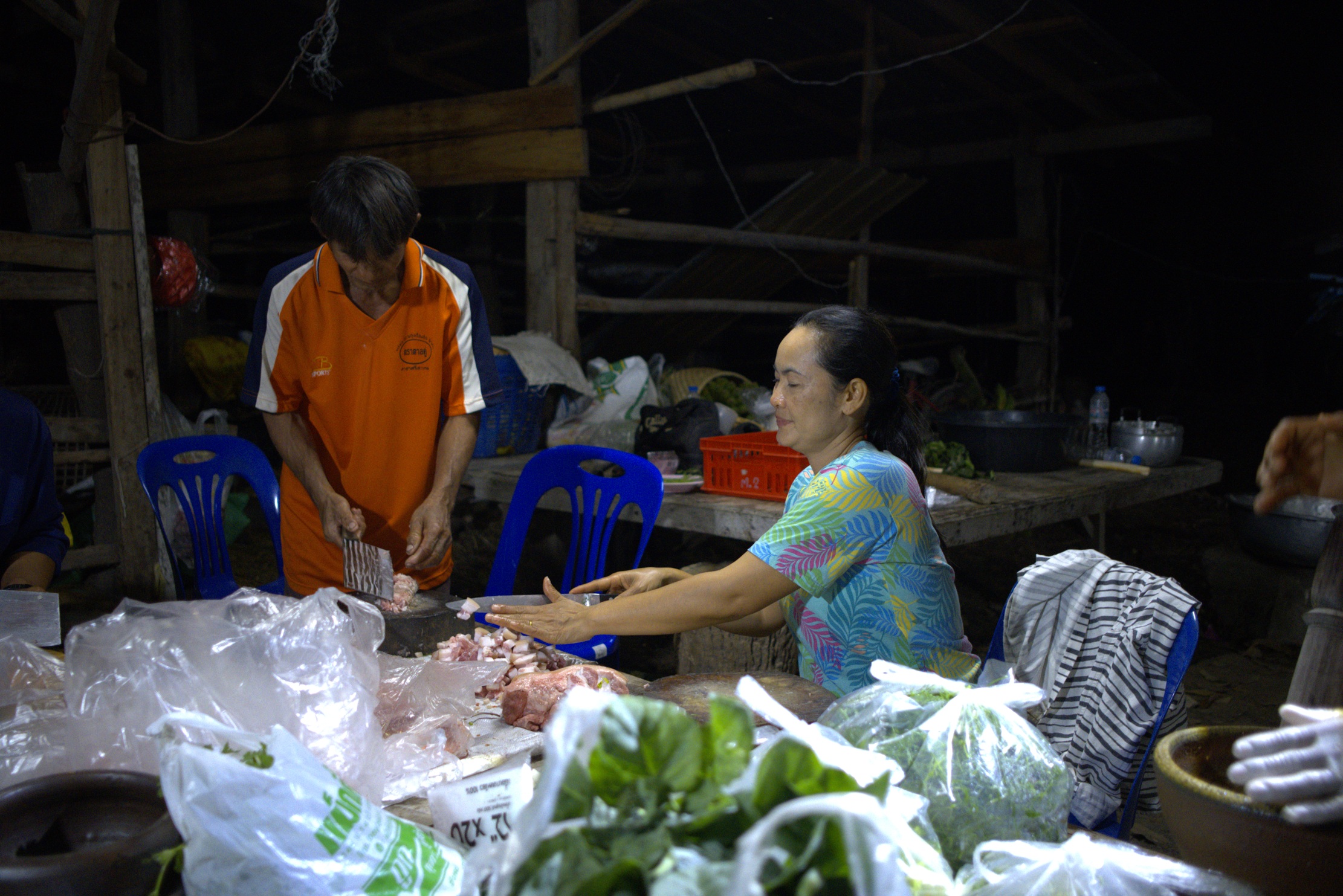
Just beyond the corridor was a makeshift outdoor food preparation area where half a dozen people, who had most likely been there all day, were cutting meat, slicing vegetables, stirring rice, washing dishes, and organizing what was clearly shaping up to be an elaborate meal. Their movements were efficient and practiced, conversations flowing easily between tasks.
There was no announcement. No visible coordination. Just a shared understanding of what needed to be done.
As I circled back toward the area where the crowd was primarily gathered, something shifted.
A noticeably different energy began to rise into the air.
At first it was subtle. Then unmistakable.
Sounds. Movement. A change in posture. A density to the atmosphere that hadn’t been there moments before.
I began to realize this gathering carried both a different look and feel from any I had attended in rural Thailand during the year since I had been living there. I had been to family functions, weddings, ordinations, and a few funerals. I had witnessed deeply moving cultural events that made it clear I was far inside a part of the world where things unfolded differently than anywhere I had known.
But this felt different still.
The live music that had begun to play carried an almost transcendent vibration. Rhythmic. Hypnotic. Guttural vocals pierced the air. The sound was beautifully seductive and somehow eerie at the same time.
The language felt different too.
With a measurable Khmer and Lao presence in this region, I had grown accustomed to hearing a mashup of Lao, Thai, and Khmer spoken in everyday conversation. But this, I would later learn, was distinct Northern Khmer. A folk dialect with its own cadence, its own tonal gravity, its own musicality.
It moved through the air differently.
Even without understanding the words, I could feel it settling into the gathering, like something ancient being quietly invited back to inhabit the space.
And for the first time that evening, I sensed clearly that whatever the candles had set in motion that morning, this was not just another village gathering.
Something else was beginning to unfold.
The crowd that had formed, now pressing three and four deep against a bamboo barrier set up along the edge of the property, had grown noticeably larger. Everyone was fixated in a singular direction.
I couldn’t make out what it was.
I was positioned slightly below the main gathering, and too many bodies obstructed my view. But I could hear a rather animated group chanting near what I made out to be the center of the cordoned-off space. From where I stood, I could see above the bamboo barrier, onto a ceiling woven from leaves and long grasses. Wide green banana leaves had been folded and shaped into birds and fish. Small bundles of dried grasses hung alongside bags of what looked like handmade bread rolls, all suspended gently overhead.
It felt ceremonial. Intentional. But still, I didn’t yet understand what I was looking at.
Through slivers of light between legs, I could see plumes of incense smoke rising from a low table arranged with bottles of water and brightly colored liquids. On the ground beneath it, bottles of beer and Thai whiskey were spread out in careful disarray. Nearby sat what appeared to be a pig’s head, surrounded by fruit and garlands.
Then another pig’s head briefly flashed into view.
My curiosity getting the better of me, I swung the camera slung over my shoulder up into a more secure position and carefully waded forward. I slipped between small openings, apologizing quietly as I moved, not fully realizing that I was weaving my way toward nearly dead center of whatever was unfolding.
Squeezing close to the chest-high bamboo fence, I suddenly found myself right on top of it.
I still wasn’t entirely sure what I was witnessing, but now I had a mostly clear, if cramped, view.
Roughly thirty people sat cross-legged on the ground, arranged in a loose circle around a woman seated at the center. She wore a silk wrap, a white shirt, and a white shawl draped gently over her head and shoulders. In front of her sat a copper bowl engraved along its upper edge. A lit candle flickered inside, along with a few other small artifacts I couldn’t quite identify.
The candle looked to be roughly the same size as the one the woman had brought to our home that morning.
I managed to press the shutter open a few times, but my position was precarious. Carefully, I backed out and worked my way down to my original position, scanning for another route back up.
That’s when I spotted my wife.
She was comfortably positioned near the opposite corner of the square, watching quietly. I pivoted and made my way toward her. She spotted me and moved in my direction. We met halfway, between the speakers and the edge of the fence.
“What is this?” I asked. “What is happening?”
She looked back toward the bamboo enclosure for a moment before answering, as if gathering the right words.
Then she turned back to me.
“Ra maemod,” she said.
“An ancient healing ritual.”
Healing ritual, I thought. My curiosity sharpened.
“Ra maemod?” I echoed. The words were unfamiliar.
“Yes. It means witch dance. This is my aunt’s home. She is very ill. My cousins asked the teachers for ra maemod to help her. It is a very old tradition here. Khmer. Only practiced this way in this part of Isaan. The maemod go into a trance and ask the ancestors to come and heal the sick.”
Some time had passed after arriving in this village before I fully understood my wife’s place within it.
This small border community, just sixteen kilometers from Cambodia, sits along the northern edge of the dense jungle that separates the two countries. It is remote, quiet, and easy to miss if you weren’t looking for it. But within this small cluster of homes, history runs deep.
My wife’s ancestors helped establish this village.
Their name carries weight here. Not from wealth. Not from land. From respect.
Her father was a well-respected sage, someone people traveled long distances to see, seeking guidance, healing, or simply reassurance. Her grandfather and his father were also healers. Phram’s. Respected figures within the monastery. The matriarchal lineage was equally significant. Witches and weavers. Deeply connected women who harvested silk from worms and spun it into garments that were prized throughout the region.
Uncles were abbots. Monks. Farmers. Healers.
In this part of the world, wealth does not define status in quite the same way. Lineage matters. Spiritual offerings to the community matter. Quiet acts of service, carried forward across generations, matter.
Here, the family name my wife carries means something.
Early on, I was told that if I ever found myself wandering alone and uncertain, if I were stopped or questioned by someone unfamiliar, I only needed to say the names Kein or Matu. Instantly, I would be welcomed. Fed. Possibly given a ride home whether I needed one or not.
It wasn’t said as a boast. It was simply stated as fact.
My wife turned back toward the gathering, lifting her chin toward it.
“Go take pictures,” she said. “I tell you more later. Go anywhere you want. You are family here. You can go anywhere.”
After my wife’s brief explanation, just being there, now, witnessing it from such proximity and with that kind of access, I suddenly felt fully present.
And excited.
There was something about the realization that this wasn’t just another gathering, not just another evening unfolding in the village, but something older. Something carried forward. Something that was deeply rooted here for centuries.
I felt the familiar pull of curiosity tighten.
Almost giddy, I headed straight back toward the crowd, ready to test the “go anywhere” directive I had just been granted. I waded back into the fray with a heightened sense of wonder, moving carefully but with purpose, until I found myself once again pressed up against the bamboo perimeter.
As it was later explained to me in more detail, ra maemod (ra, meaning dance and maemod, meaning witch) is called upon when someone falls ill, becomes lame, or when some form of misfortune settles over a household and conventional remedies offer no relief.
When that happens, the family requests the aid of a ritual facilitator known as maemod – the most literal translation being witch, but sometimes medium – who possesses the ability to summon ancestral spirits.
The purpose of the ritual is to invite specific ancestors, ones who carry healing abilities, to return temporarily and assist the afflicted.
During the ritual, members of the family, someone believed to have been born with the ability to receive the ancestor, becomes the vessel. The ancestor is said to inhabit them, speaking, diagnosing, and guiding the healing process through their living relatives. The whole village participates, supporting the families.
The maemod serves as the intermediary, guiding the ritual, summoning the ancestral spirit, and ensuring the passage between worlds remains open long enough for healing to take place.
The scene before me began to resolve itself.
Adorned differently than everyone else, I could now clearly distinguish who the maemod were and who the afflicted, or family of the afflicted, might be. Two centers of gravity had formed within the square. Two women seeking healing, each surrounded by family members and supporters. Two maemod tending to each respectively.
Several additional maemod and assistants hovered along the periphery of each circle. Everyone seemed to be talking at once, yet somehow it didn’t feel chaotic. It felt layered. Intentional. Like multiple conversations happening inside a single shared purpose.
At the far end of the square, three young men sat cross-legged on the ground with long drums of varying sizes resting in front of them. Beside them, another musician held a beautiful bamboo pan flute that extended nearly two feet above his head. Next to him sat a man with a large nipple gong hanging from a string in front of him.
On the adjacent corner, facing the other musicians, sat a phin player, a vocalist, and someone managing a surprisingly elaborate collection of sound equipment.
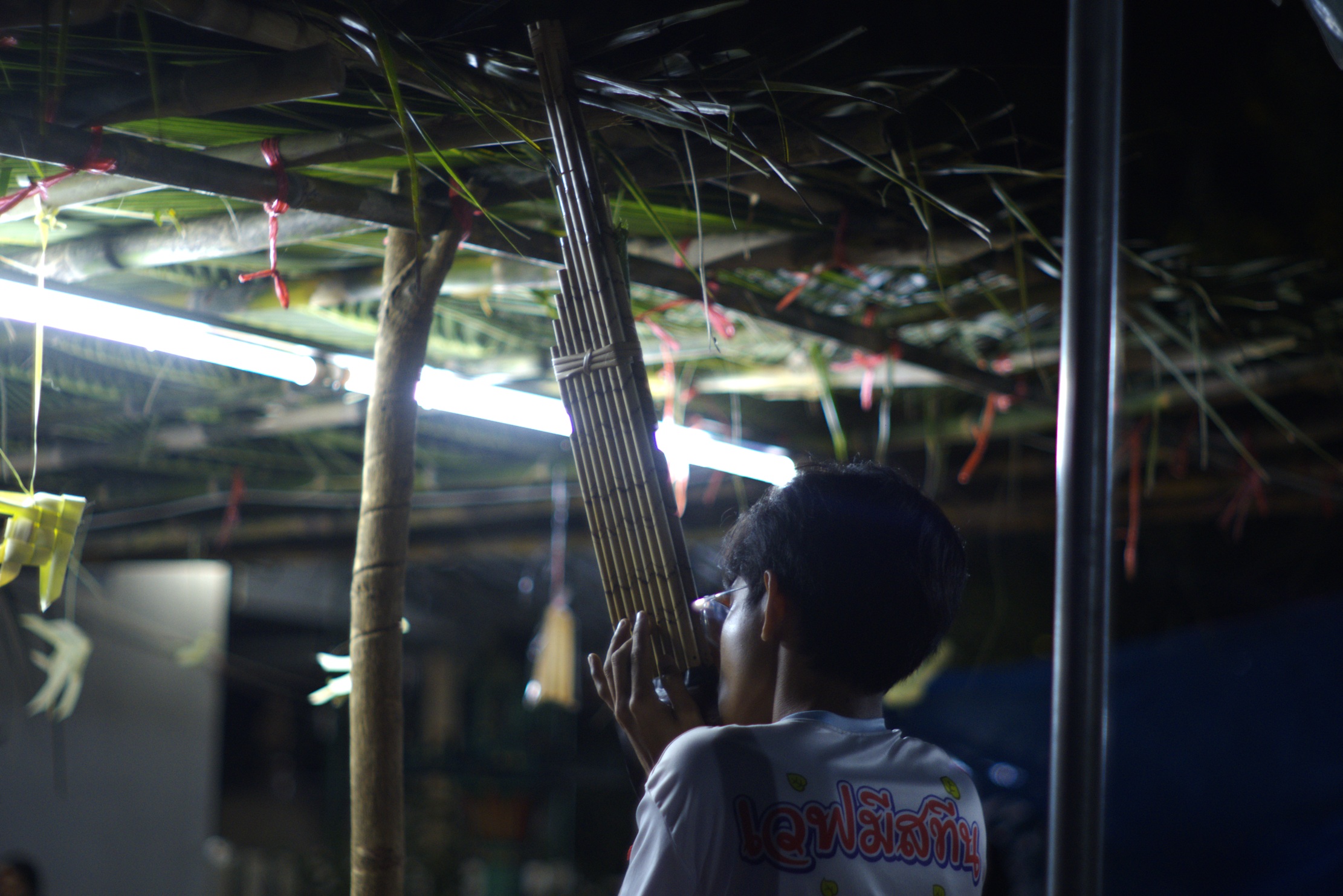
Behind them, stacked speakers towered well over six feet tall. Another matching set stood in the far opposing corner, facing outward toward the open night. The sound they produced carried easily across the fields and through the surrounding darkness. There was no doubt the entire village, and several beyond it, could hear what was unfolding.
As I jockeyed for position, I noticed a small open area behind the musicians, surrounded on three sides by a chain-link fence. It struck me immediately as the perfect place to embed myself, if I could reach it. There wasn’t a soul back there. From that vantage point I could move freely, unobstructed, with a clear view of the ritual space.
It took some maneuvering.
With the help of several gracious and understanding bystanders, who I unfortunately began tripping over in my attempt to reach it, I eventually squeezed into the space. After the small calisthenics required to land inside my coveted hide, I remained motionless behind a table for a few moments, hoping to quiet any attention I had drawn to myself.
Gradually, I rose.
With the slow patience of someone trying not to disturb a delicate balance, I lifted the camera, opened the lens wide, and took in the ritual space that had been so carefully prepared.
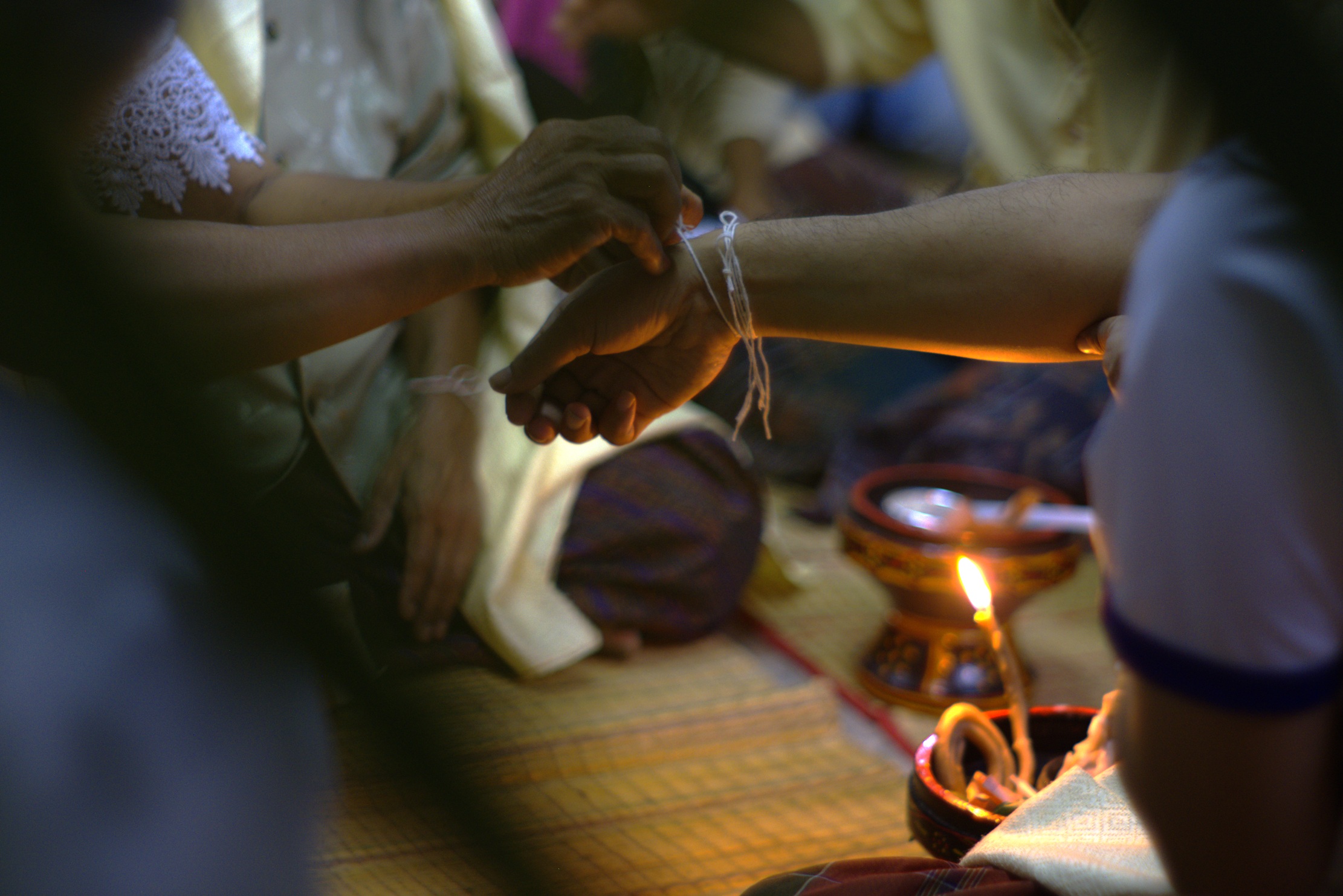
To my left, family members surrounding their loved one began, one by one, tying plain white cotton strings, known as sai sin, around the wrists of the presiding maemod. It was a gesture of reverence and support. A quiet offering of good fortune and strength before the ritual deepened.
The maemod returned the gesture, tying similar strings onto the wrists of family members. A reciprocal exchange. Blessings moving in both directions. Protection, strength, openness of spirit, all quietly acknowledged through these simple white threads.
The air felt different now.
Not louder. Not necessarily more animated.
Just heavier with intention.
As the final strings were tied, it became clear that whatever was about to happen next, the ritual had crossed an invisible threshold.
This part of the ceremony served as an entry point.
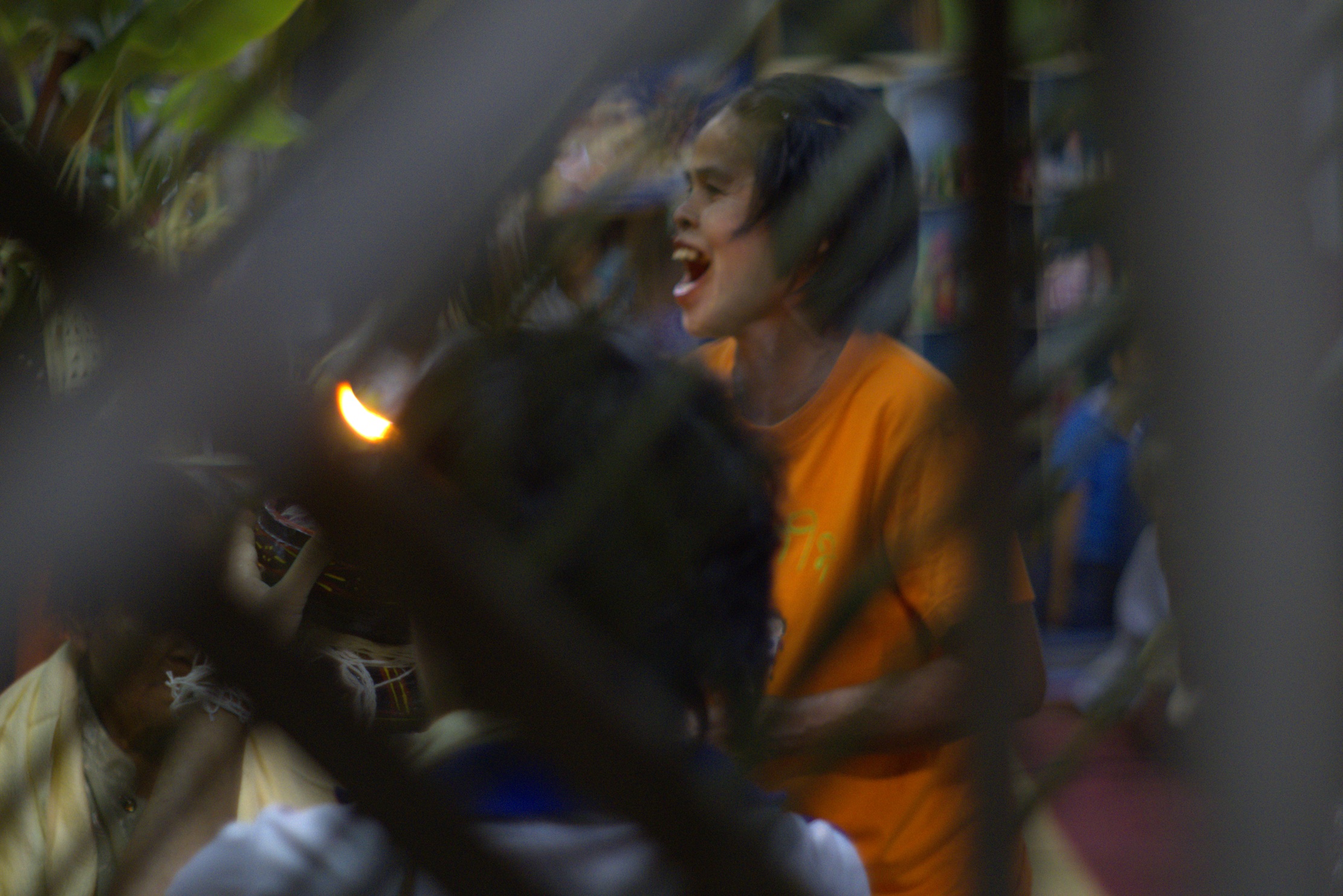
Raucous cheers rose. Voices lifted. Animated chanting moved through the crowd in waves, designed to arouse the spirits and direct attention toward the afflicted. The music followed, often swelling to a near-deafening intensity, as if sound itself were being used to open a door.
Shifting my attention from the group to my left to the one on my right, I noticed the male maemod, who appeared to be the primary facilitator among the group, now seated closer, directly across from the woman he was charged with helping.
A silk wrap, colored and striped in a pattern specific to this region, crisscrossed his chest over a white shirt. Another was wrapped around his waist. A third lay draped nearby, which he alternated between placing around his head and removing again as the ritual progressed.
An assistant sat beside him. Another stood just behind, with a woven basket at his feet filled with various artifacts and a bundle of similar silk wraps. Resting across the top of the basket was a small sword.
The maemod, along with those seated closest to him, began an ongoing chant directed toward the woman in front of him. At times the chanting rose sharply in intensity, voices overlapping, then falling again into a quieter rhythm.
The woman lifted the copper bowl with the burning candle toward her head, bowed over it, then placed it carefully on the ground in front of her.
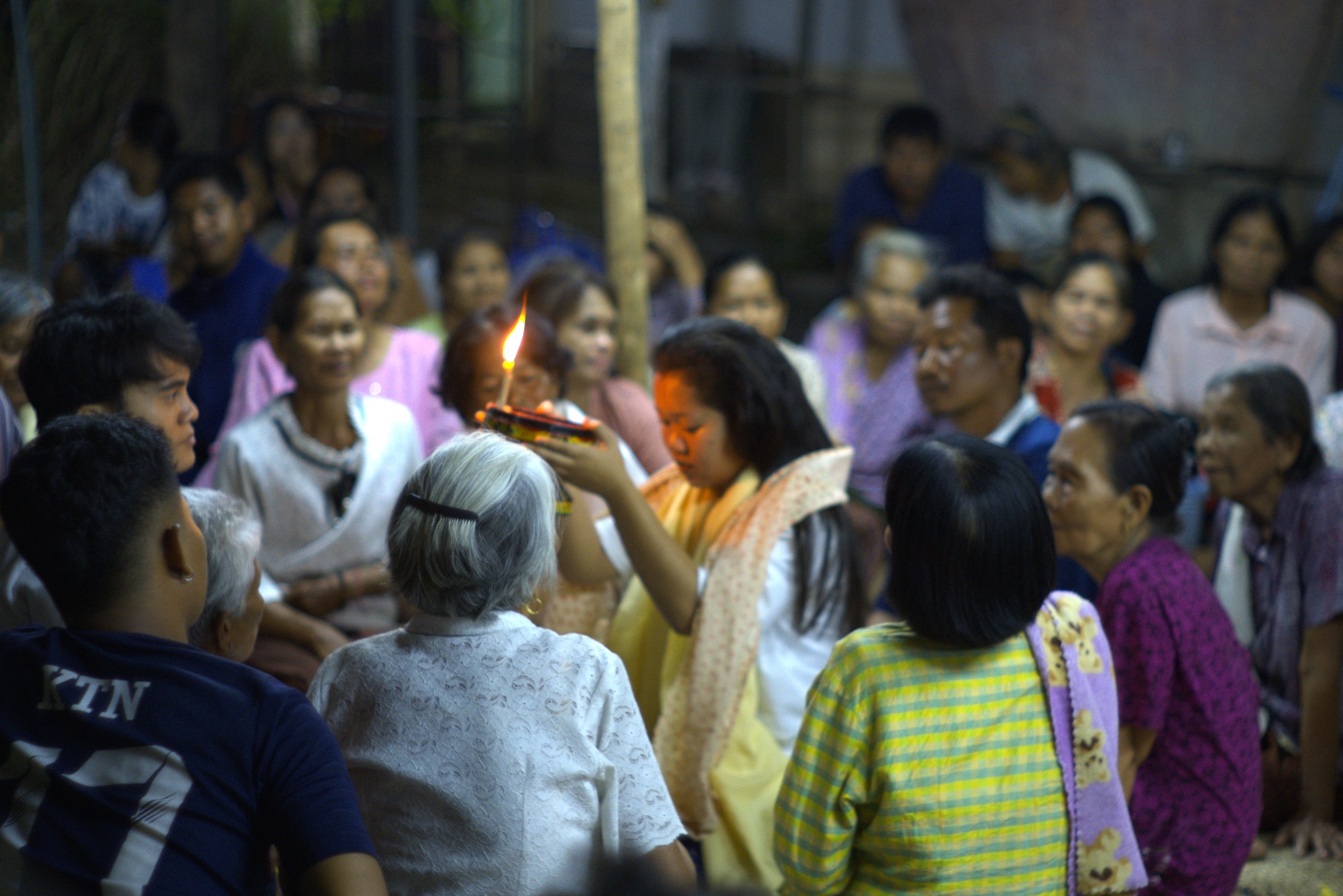
The maemod took possession of the bowl with both hands. Almost immediately, he began throwing himself back and forth, his head whipping from side to side as if already overtaken by something unseen. He chanted loudly, his voice cutting through the music.
He repeated the movement several times, each cycle raising the energy of the entire group seated around him.
The musicians tracked the movement with remarkable awareness. The tempo rose and fell in response to the shifting rhythm of the ritual. The drums pulsed. The phin threaded through the air with a sharp, metallic melody. The gong rang at measured intervals.
At times the music softened into something almost lulling, beautiful and hypnotic. At others, it surged with such volume and force that you could feel it moving through the ground, up your legs, into your chest and throat.
Around the perimeter, the observers, now perhaps fifty or more, stood quietly, pressing inward, their attention fixed on the unfolding scene.
As I scanned the gathering, I saw toddlers sitting in their mothers’ laps. School children. Teenagers. Elderly men. Women standing shoulder to shoulder. Dogs resting quietly along the edge, as if this were simply another evening in the village.
I could now see the shrine clearly at the center of the square.
It contained an elaborate arrangement of leaves and fruits, alongside opened bottles of orange Fanta, cola, bottled water, and glasses filled with each. Platters of food had been carefully prepared: rice, pork, vegetables, curry, bamboo shoots. The pig heads rested prominently on trays, surrounded by whiskey and beer, already poured into waiting glasses.
All of it had been arranged as offerings.
For the spirits.
For the ancestors who were expected to arrive.
It was clear now that this shrine was not decorative. It was central. A focal point that would soon take on greater meaning.
Both groups began intensifying in sound and movement.
Something was shifting.
Beyond the brightly lit square, darkness pressed in from all sides. You couldn’t see more than a few feet beyond the ritual space. The effect was striking. It felt as though the ceremony existed inside its own contained world, carved temporarily out of the night.
The group to the right rose onto their knees, clapping and bouncing to the rhythm of the music, calling out in unison. The maemod remained seated, a white scarf now wrapped behind the woman’s neck. Grasping both ends, he pulled gently but firmly as she began throwing the copper bowl in circles in front of her, dragging it along the ground.
The contents spilled out.
The candle flickered wildly, then rolled free.
The chanting intensified. The clapping grew louder. Voices rose in encouragement, as if urging something forward.
Then, all at once, the woman fell partially backward, her head tilted toward the sky.
She paused there.
Then she folded forward at the waist, nearly in half, where she remained.
Tears.
She stayed that way for several long moments.
The maemod remained beside her, one hand resting gently on the back of her head, the other on her shoulder. Nearby, the other attending maemod rose to their feet and began moving in small, deliberate gestures, their movements slow and measured, creating a quiet, mystical atmosphere.
The tempo of the music shifted.
The smell of incense thickened.
The entire space seemed to settle into a synchronized hum.
Gradually, the assisting maemod and family members helped the woman to her feet and guided her toward the shrine at the center of the square.
They adjusted her silk wraps into a new configuration, signaling the presence of the ancestor.
The transformation was subtle but unmistakable.
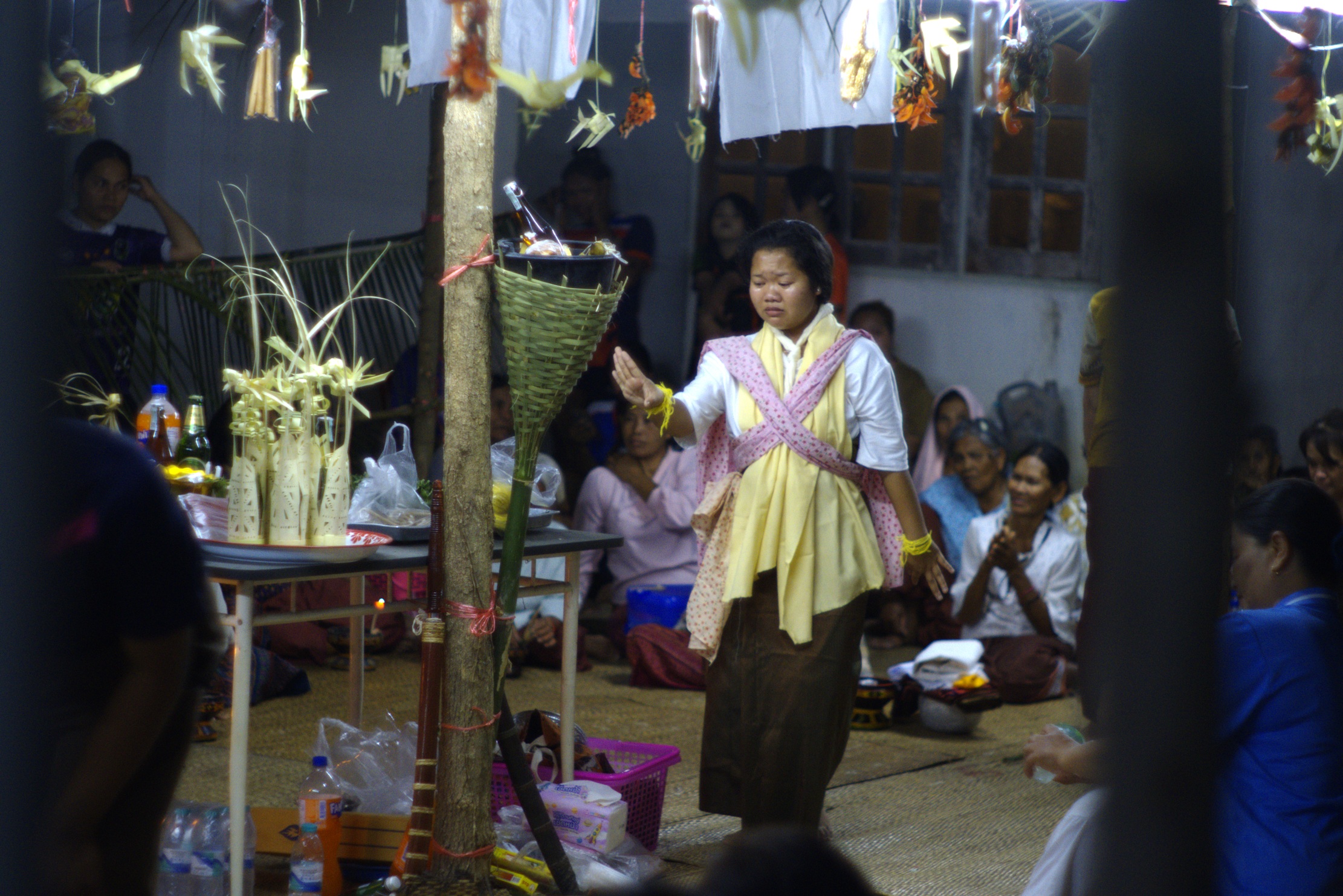
Upon the ancestor’s arrival, the medium was guided slowly around the shrine to receive the offerings. The movement transitioned naturally into a traditional Khmer dance, circling the shrine in slow, deliberate steps.
The head maemod led the procession, the small sword now in hand. Lit candle affixed to its end.
Wrists turned outward. Fingers bent and twisted in graceful patterns reminiscent of Apsaras – heavenly, immortal dancers moving in a classical Khmer form whose influence still lingers in this corner of southern Isaan.
One by one, the other maemod joined.
After some time, family members entered the circle as well, each now adorned in different configurations of silk wraps drawn from the basket near the shrine. Some were arranged elaborately on their heads. Others crisscrossed across their bodies in layered patterns.
The circle widened around the center shrine.
The movement slowed.
And the village, now gathered around the edges of the square, watched quietly as the night moved gently in circles.
I lowered the camera for a moment.
Witnessing this for the first time created a quiet but overwhelming wave of emotion in me.
Gratitude, certainly. But also something deeper. A feeling of being folded gently into something that had existed long before I arrived.
These rituals are private. Deeply cultural. Family-centered. To be given the access I was given, to move freely within the space, to photograph without resistance, made me feel less like a foreigner living in their village and more like a family member. A neighbor not just welcomed, but trusted.
There is a difference between being accepted and belonging.
This felt closer to belonging.
In the West, breaking bread together is often seen as a way of establishing community and cultivating trust. Sharing this ceremony carried a similar feeling, though perhaps even more profound. Although I had already been living in the village for some time, and had developed meaningful relationships, participating in something this intimate deepened those connections in a way that felt both quiet and significant.
No one announced it. No one acknowledged it.
But it was felt.
In the village, there is an unspoken rule that ceremonies and celebrations must quiet down at midnight. It’s rarely discussed, never enforced, and yet always respected. Music fades. Voices soften. Gatherings dissolve naturally into the night.
But when it comes to ra maemod, this rule does not apply.
The ritual often continues well into the night, sometimes all the way through to morning. It isn’t unusual to hear the music still reverberating across the fields as the sun begins to rise again.
Around 11:30, we decided to make our way home.
My wife took the motorbike ahead while I opted to walk.
It was a beautiful night, and walking felt right.
The air had cooled, and the sounds of the ritual drifted gently behind me as I moved down the dirt road toward home. The village had settled into its nighttime rhythm. A few distant lights glowed beneath houses raised on stilts. Dogs made me aware of their presence, then fell quiet again. Somewhere, a conversation murmured softly.
The music followed me as I walked.
Later, lying in bed with the kitchen window open and the sound of the ritual still floating softly through the night air, I found myself reflecting on what I had witnessed.
What I had seen was not unusual here.
It was not rare. It was not performed for outsiders. It was simply part of life. Woven into the fabric of the village as naturally as dinner, or the morning market, or the slow rhythm of a day unfolding.
And somewhere along the way, I realized something else.
It had begun to settle into me in a similar way. As something natural. Unalarming.
There was a time, not so long ago, when nuance didn’t have the breathing room in my world I thought it had.
It wasn’t until I found myself here that I noticed a quiet rigidity still lingering.
It has softened since. And in many ways, faded.
And I’m grateful for that.