
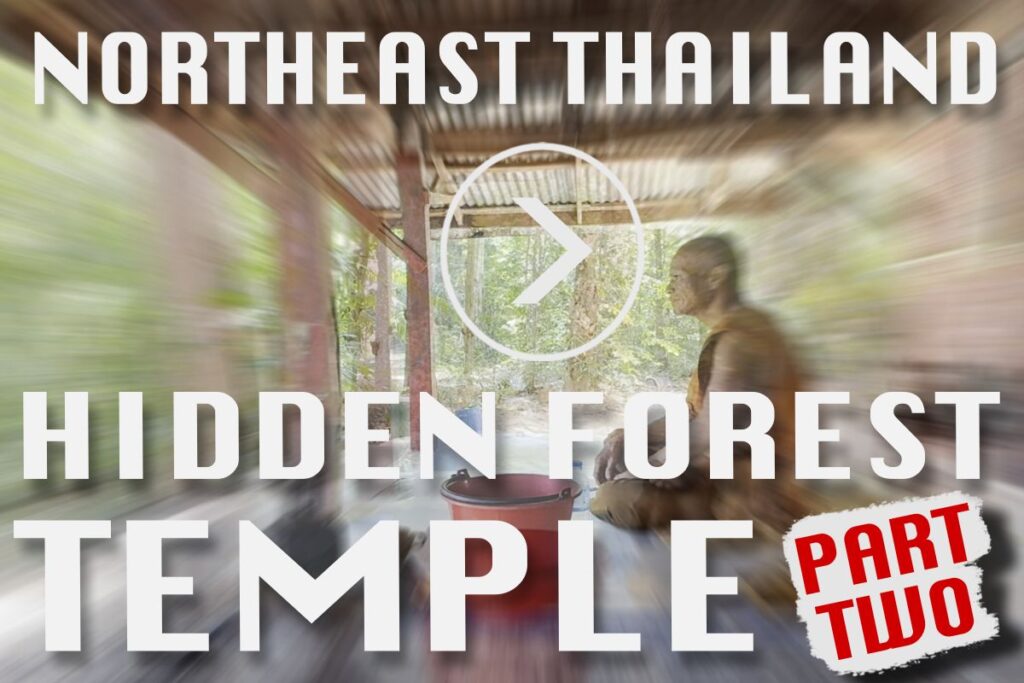
Forest Temple – Part Two
Just eight kilometers from our village lies one of the most energy-dense, mysterious forest temples in all of Thailand: Wat Tham Sarapong. Tucked near the Cambodian border, this site was once home to people from diverse backgrounds who came together to form the original settlement of Najaria.
Decades ago, Princess Chulabhorn traveled through this region and witnessed the poverty and hardship faced by the villagers. She intervened directly—constructing a new village, allocating farmland, building homes for each resident, gifting every household one cow and one pig, and renaming the community Ban Thap Thim Siam 06.
Today, the temple is a forgotten sanctuary slowly being reclaimed by the jungle.
Returning to the Forest Temple
In Part One, we wandered the outer grounds cautiously, feeling more like intruders than visitors. We promised to return with a deeper look. With the border conflict intensifying and many nearby villages now gated or guarded, we weren’t sure we’d be able to slip through. But my wife knew a way—quiet, unmarked, and just outside the checkpoints.
We made it in. The monks, only five remaining, were surprised to see us but welcomed the unexpected company.
A Place the Locals Call Ancient
Many villagers believe this temple once stood on the site of an ancient royal palace or a city that collapsed more than 2,000 years ago. When you stand there, it’s not hard to see why. The main temple rests beneath a vast circular cliffside of sheer rock, shaped like a natural amphitheater. Beneath this wall lies the Sleeping Buddha, positioned above what was once a powerful waterfall that flowed down into the lake below.
Crossing Into the Old World
Exploring the upper levels, we crossed a simple but striking arched bridge—once spanning a river that fed the temple grounds. We passed abandoned monk quarters, meditation huts, and wide marble staircases leading to outdoor gathering spaces long overtaken by vines.
Inside one marble-lined chamber, frozen in time, we found ornate statues and what felt like the remnants of a grand hall cut straight from another era.
The Descent
A narrow staircase led downward. Halfway into the passage, a dozen giant bats burst from the shadows, sending us scrambling back. After a brief reset, I ventured down again. The bats had moved on. Below was a hidden bathing area for monks—placed one level beneath the Buddha out of reverence.
A Monk, a Lake, and an Ancient Trail
Outside on the lowest tier, we followed a path toward the old burial grounds, the lake, and a remote monk dwelling perched just above the water. The monk assigned to this area greeted us warmly—likely the first outsiders he’d seen in a very long time.
When my wife asked permission to film, he became animated, eager to show us something sacred. He led us up a steep rock incline to what he described as 10,000-year-old hoofprints—ancient impressions left by water buffalo traveling from the high pastures down to the lake.
Moments later, as if summoned by the land itself, a villager appeared leading a large herd of buffalo to the water. They moved exactly as the monk had described. But one buffalo spotted me… then another. When the lead animal climbed out of the lake with clear intent, I retreated up the incline to the sound of the monk’s uncontrollable laughter.
A Final Look Back
We ended our visit where we began: beside the sheer rock canyon where water once fell in a way that pulled you into a trance-like meditation. But now we stood on the opposite side, connected by pathways that felt folded through time.
This temple is a living fragment of ancient Isaan—a world hidden in the borderlands, untouched, unpolished, and almost entirely forgotten.
Thank you for tagging along. Part Three may be closer than you think.
#Buddhism #NortheastThailand #Isaan # RemoteTravel