
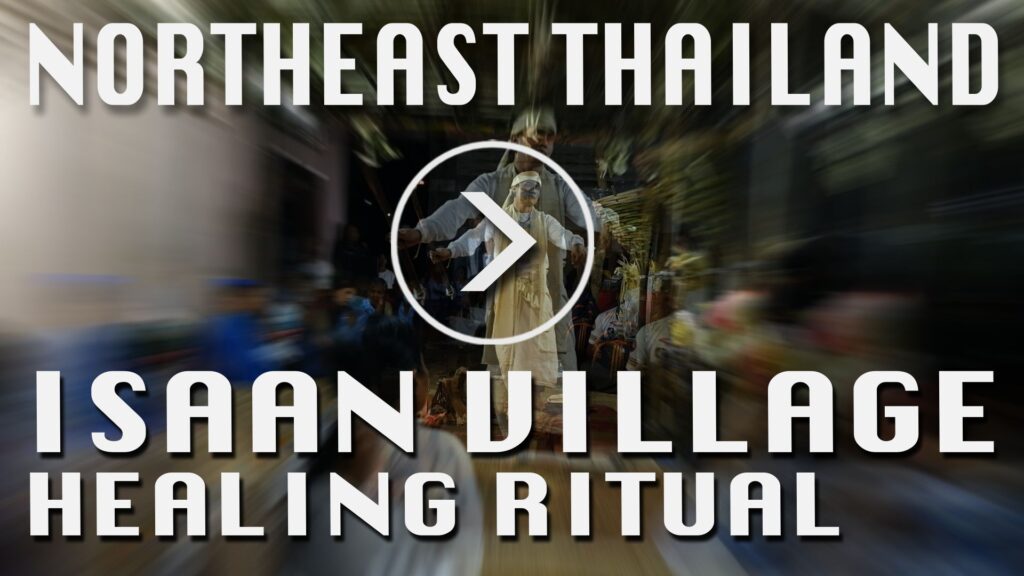
Last night, I was invited to film a ritual known locally as ram ma’moed.
In Thai, the words themselves are unremarkable. Ram translates to “dance.” Ma’moed means “witch,” “sorceress,” “spirit woman.” Put together, here in this village, it simply translates to “Witch Dance.”
But like many things here in South Isaan, the English language struggles to carry the weight of what that actually means. The Romanized translation flattens it. Thins it out. Search engines don’t help much either. Academic references are sparse, and where they do exist, they tend to miss the point.
Because on the ground, in villages like this one — the practice isn’t rare, dramatic, or symbolic in the way Western audiences often expect. It exists quietly. At human scale.
What It Is, Plainly
Ram ma’moed is a ritual healing dance, most often associated with female mediums. It may involve trance, channeling ancestral spirits, possession, or some combination of those things. But it isn’t a performance in the usual sense. It isn’t staged. It isn’t announced.
It happens because it still needs to happen out here.
No one is trying to explain it. No one is trying to defend it. No one is trying to sell it.
It isn’t framed as “culture.” It isn’t framed as “belief.” And it certainly isn’t framed as spectacle. It simply lives as part of the fabric of daily life.
Why It Lives Here
Its roots are deep and Southern Isaan isn’t just “Thai.” Culturally, it emerges from an overlap of Lao traditions, Khmer influence, animist belief, deep ancestral orientation, and Buddhism. These layers weren’t asked to replace one another. They were allowed to stack.
Many of the rituals practiced here predate the idea of Thailand as a nation. They were shaped long before borders, long before centralized religion, long before modern categories were enforced from above.
And that history shows.
What struck me most wasn’t the ritual itself. It was how unremarkable it was to the people involved.
There was no sense of rebellion. No sense of opposition. No sense that this needed justification.
It wasn’t framed against Buddhism. It wasn’t framed instead of anything.
It simply existed alongside. Alongside neighbors. Alongside the road. Alongside meals and children playing.
The Problem Isn’t the Ritual, It’s the Word
Now, about that phrase… Witch Dance.
There’s a problem with that word, witch. Not the practice. Not the people. The word.
In English, witch arrives already poisoned. Suspicious. Fearful. There’s something slightly contaminated before you’ve even said the rest of the sentence. For most Western ears, it’s impossible to hear the word without centuries of accusation riding along with it.
But that wasn’t always the case.
Before “Witch” Became an Accusation
Before the word carried that heavy weight, the role it described was largely practical. Ordinary, even. In many pre-Christian European cultures, the person referred to as a witch was simply someone who knew things.
A healer. A midwife. A keeper of seasonal knowledge. A reader of signs. A mediator between the visible and invisible parts of life.
These weren’t fringe figures. They were functional. Necessary. Often deeply respected — especially when those roles were held by women. And yes, throughout history there were men who filled similar roles. But the authority most often targeted, most often erased, was female.
What’s important to understand is this: the work didn’t change.
The knowledge didn’t suddenly become dangerous. The rituals didn’t suddenly turn dark. The people didn’t suddenly become evil.
What changed was who was allowed to hold authority.
How the Word Got Poisoned, Probably
As centralized religion took hold, especially Christianity in Europe, it required something very specific in order to function: a monopoly on meaning. A single, sanctioned explanation for how the world works. Who speaks for the unseen. Who mediates between humans and whatever lies beyond.
Local spiritual authority, especially authority that wasn’t written down, wasn’t institutional, and wasn’t male, represented a problem.
Not because it was wrong, necessarily. But because it was ungovernable.
So the word shifted.
What once described a role became an accusation. What once described knowledge became heresy. And eventually, what once described care became evil.
This wasn’t accidental. It was engineered.
Centralized religion began replacing local spiritual systems. Unsanctioned knowledge became suspicious. The unseen stopped being mysterious and became dangerous. And anxiety about uncertainty slowly turned into anxiety about dissent.
But underneath all of that was something simpler and more durable:
Moral absolutism.
Once belief systems harden into binaries — good and evil, saved and damned, pure and corrupt — nuance dies quickly. And when nuance dies, anything that doesn’t fit cleanly into the approved categories becomes a threat by default.
The witch didn’t become evil because she was evil. She became evil because she couldn’t be controlled.
Because her authority didn’t flow through an institution. Because her knowledge couldn’t be audited. Because her power didn’t ask permission.
And once that frame was established, everything followed naturally: fear, accusation, trials, purges. Not because society suddenly lost its mind, but because binary thinking leaves no room for coexistence.
There’s only replacement. Only purification. Only elimination.
What Felt So Foreign About That Arc
What struck me, watching ram ma’moed here in Thailand, was how foreign that entire arc feels. Not because the rituals are similar because they’re not, but because the structure of belief is different.
Here, belief systems didn’t evolve competitively. They evolved additively, even complementarily.
Instead of: “This replaces that,” the logic was: “This lives alongside that.”
So Buddhism didn’t erase animism. Ancestor spirits weren’t declared false. Ritual specialists weren’t hunted. And female spiritual authority didn’t need to go underground to survive.
No one had to poison the word witch. No one had to burn the practice out.
And so these rituals remain ... not loudly, not defiantly, just intact.
When belief systems leave room for overlap, no one needs to become a demon.
And that, more than anything else, is what the word witch reminds us of. It's not what people once feared, but what happens when cultures lose the ability to live with ambiguity.
The Personal Lesson I Keep Coming Back To
There’s a temptation, especially in Western culture, to demand alignment.
To push belief into lanes. To require people to pick sides — spiritually, politically, ideologically — and then perform loyalty to that choice.
Certainty becomes currency. Ambiguity becomes suspicious.
But when differing beliefs aren’t allowed any oxygen at all, something strange happens.
The people enforcing purity slowly begin to resemble the very thing they claim to oppose.
Zealots arguing with zealots. Rigidity meeting rigidity. Certainty shouting at certainty.
It doesn’t actually matter which side you’re on. The structure is the same.
Don’t misunderstand: living alongside differences doesn’t mean absolute acceptance of them. It certainly doesn’t mean accepting harm or destruction behind differences. Discernment is still required. The distinction matters.
But cultures that fear ambiguity tend to invent demons. Cultures that live with ambiguity tend to invent rituals.
What I’m Trying to Make Space For
What I witnessed here wasn’t a rejection of modernity, or a rebellion against religion, or a statement about belief at all.
It was coexistence, practiced quietly.
No one was asking for permission. No one was asking for validation. No one was demanding agreement.
And because nothing needed to be purified or eliminated, nothing needed to be demonized.
I’m not interested in turning this ritual into an argument. I’m not interested in flattening it into a metaphor. And I’m not interested in telling anyone what to think about it.
This work isn’t about making a statement.
It’s about making space.
Space for curiosity. Space for difference. Space for the possibility that not everything needs to be resolved into a binary before it can be respected.
If there’s something to be discovered here, it won’t come from being told. It will come from being witnessed.
Refuge in the Middle
The irony isn’t lost on me that in the places most obsessed with freedom, independent thought often requires choosing a side and then making noise about it.
Riding the center rarely attracts attention. It doesn’t convert well. It doesn’t outrage efficiently.
But it does something else.
It offers refuge.
And in a world increasingly monetized through rage, refuge may end up being the most radical thing of all ... even if it takes a while for people to realize they’re looking for it.